Racing Bones, Sailor’s Soul: Ipsum 45 Trimaran
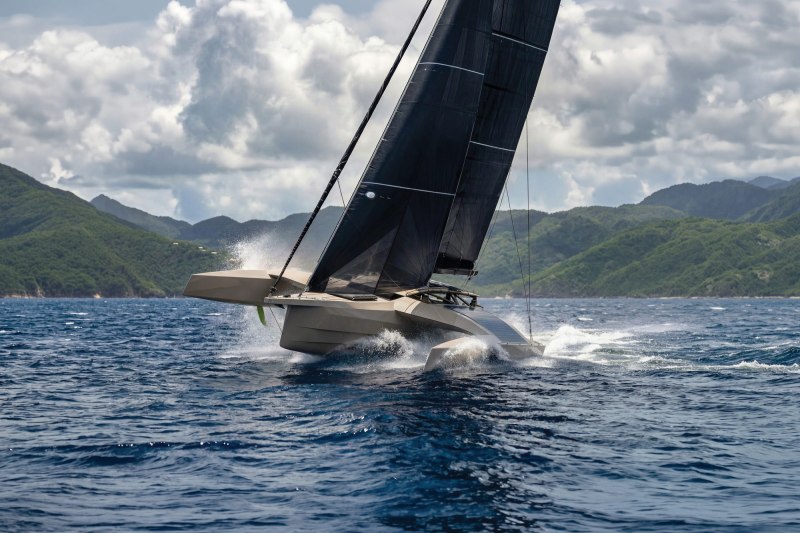 The Ipsum 45 trimaran combines lightweight construction, wave-piercing lines and a design philosophy that lets the boat evolve with its owner.
Courtesy AWA
The golden era of multihull sailing included visionaries who drew radical boats, built them by hand, and then boldly sailed them offshore to prove their theories were right. The French design studio AWA (Apparent Wind Activities), founded by naval architect Loïc Goepfert and designer Julien Boucher, has now introduced a concept that honors the soul of those revolutionary sailors.
The Ipsum 45 trimaran takes the elements the multihull pioneers were chasing—lightweight design, glide, organic curves, long lines, wave-piercing shapes—and rebuilds them from the inside out using advanced naval engineering tools. The Ipsum starts with a master base kit, aptly named the Nucleus. These are precision-engineered structural components of a 45-foot skimming trimaran that fit inside a 40-foot container. The base structures are designed for high performance, using computational fluid dynamics. Naval architect Guillaume Verdier, known for fast offshore racing machines, lent his name to the Ipsum’s hull.
From that foundation, the owner sets the course. Construction materials scale from wood-epoxy composite to full carbon. Owners can work with any yard or build the rest themselves. Custom add-ons can be ordered: appendages, modular interiors, modular aerodynamic arm fairings, CNC flat panels, float covers and a variety of roof covers.
The aesthetic runs from classic to ultra-modern, with a CE-certified, turnkey build available through France’s premier racing yards. Other naval architects and interior designers are invited to bring their own vision to the foundation. This makes the Ipsum project less a single boat than a collaborative ecosystem for builders, designers and sailors worldwide.
At the heart of that structure is an idea as practical as it is elegant: Build once, to a high standard, and let everything else evolve from that. The continuous bow-to-stern roof, derived from Goepfert’s work on the offshore raceboat Gitana 18, carries all structural loads through an outer exoskeleton, eliminating internal bulkheads. The freedom this unlocks for the interior design is significant, with an open central hull that’s more than 11 feet wide with almost 7 feet of headroom throughout.
In most production boats, furniture is laminated to the structure, bulkheads are permanent, and the interior ages around its first owner’s choices. On the Ipsum, the first owner might keep things stripped out and simple. Years later, that same hull can become a proper cruising interior with a master stateroom, galley, dining table and salon. The next steward of the boat may want something that falls in between. The boat evolves with the sailor, giving it longevity in a world that needs less disposable production.
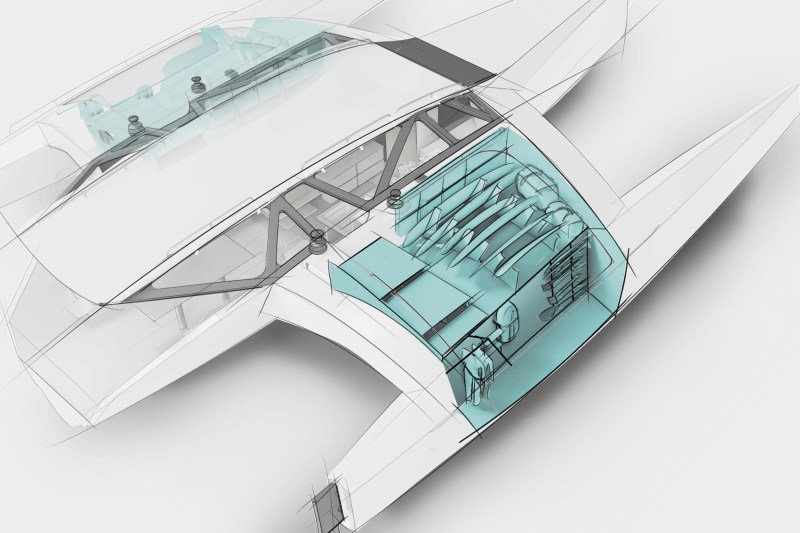 On the Ipsum, an open-net configuration remains available, but the interbeam space can also be enclosed by an aerodynamic beam structure, open at the sides and covered overhead, creating a genuinely usable volume the designers call the Newing.
Courtesy AWA
The structural roof on the Ipsum does double duty: It stiffens the platform while creating a cockpit that no conventional trimaran can match. Full coverage, 270-degree visibility from the helm, and an open section that lets in light, air and sky without compromising protection from the elements. It allows sailors to be inside and outside simultaneously. A wheel or a tiller can be configured to fit the needs of an offshore sailor or a day racer.
That same customizable philosophy extends outward to the area between the hulls. Most trimarans surrender that space to a trampoline net. On the Ipsum, an open-net configuration remains available, but the interbeam space can also be enclosed by an aerodynamic beam structure, open at the sides and covered overhead, creating a genuinely usable volume the designers call the Newing.
Three Newing configurations are offered. The Adventure Hub is a wing room that stows equipment and toys like kiteboards in a protected launch platform. The Escape Pod Suite takes its inspiration from van life, with composite sides that unfold and pop up. This pod has its own entrance, integrated head, mesh screen and berth. The third option is a blank canvas for a workshop, art studio, meditation space or anything else.
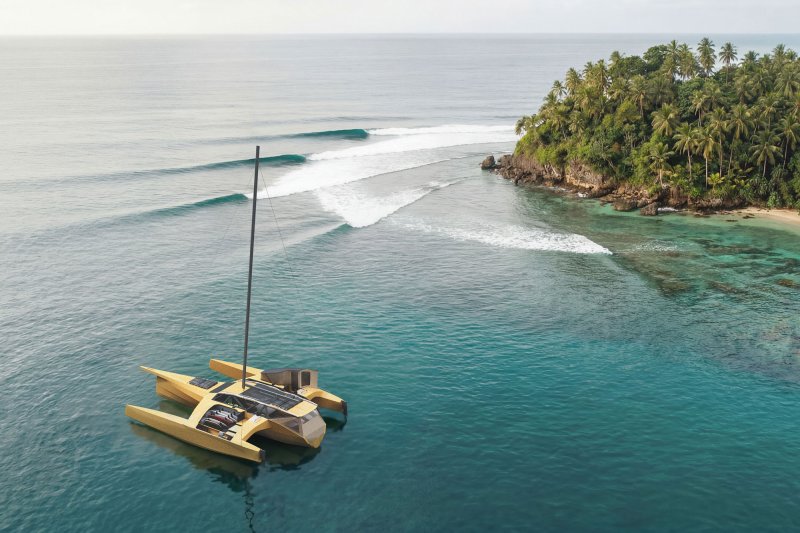 The structural roof on the Ipsum does double duty: It stiffens the platform while creating a cockpit that no conventional trimaran can match.
Courtesy AWA
There also are two rig options. The Classic Rig is a high-performance fractional setup with a sail inventory that can be sourced, repaired or replaced in any port in the world. The ACC Wing Sail option is a thick-profile cambered wing sail with an automated trim system that adjusts camber in real time, absorbing gusts and optimizing airflow.
Overall, the Ipsum asks the owner to make real choices: materials, rig, interior, the space between the hulls. Options are distilled down to the essentials. This is arguably the most honest, pure and beautiful way to go to sea.
The post Racing Bones, Sailor’s Soul: Ipsum 45 Trimaran appeared first on Cruising World.