Pointers for Installing an Autopilot
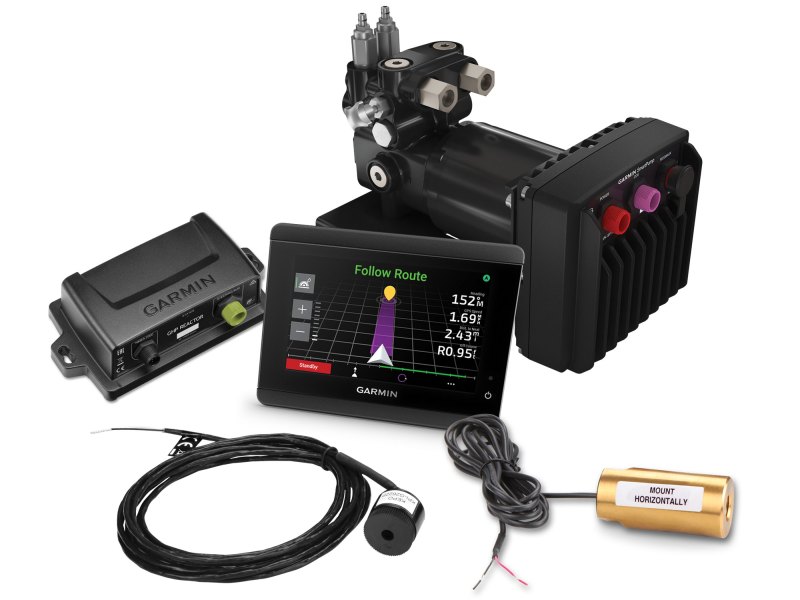 Autopilot systems, like the Garmin Reactor 40 Hydraulic Core Pack, can make running a boat much easier.
Courtesy Garmin
BUY NOW
Autopilot systems, like the Garmin Reactor 40 Hydraulic Core Pack, can make running a boat much easier.
Courtesy Garmin
BUY NOW
Marine autopilot systems offer amazing benefits for today’s boaters. Integrated with various sensors via NMEA 2000, an autopilot system not only can steer a course and take you to a waypoint, but also execute intricate turning patterns and more. But, to achieve optimum autopilot performance, proper installation and set up is paramount.
You should of course adhere to the manufacturer’s installation instructions. However, there are details that bear emphasizing, says Garmin’s David DeVos. We asked DeVos for pointers focusing on the Garmin Reactor 40 Hydraulic Core Pack (Part No. 010-02794-01), a popular choice for hydraulic steering systems for single and twin outboards. Priced at $4,399.99 with a GHC 50 control display, it also includes a Smart Pump V2, Electronic Control Unit (ECU), Course Computer Unit (CCU), and Shadow Drive, as well as plumbing connectors and NMEA-2000- and power-cables.
Pump OrientationIdeally, orientation of the hydraulic autopilot pump should be horizontal, as on a table top. But if the only way to mount the pump is in a vertical orientation, the pump head (where the hoses connect) should be at the top to help facilitate purging the system of air. The pump should also be mounted in a dry location to help prevent corrosion of the pump and ECU (which is integrated with the Garmin Smart Pump V2).
Power Delivery“The autopilot pump needs good, clean 35 amps of 12-volt DC current to optimize performance,” DeVos says. “The Reactor 40 pump includes a duplex power cable with a 40-amp fuse, but if you need to extend the wires, use AWG 10 or 8 marine wire to ensure strong power delivery.” To determine the proper wire gauge, visit
circuitwizard.bluesea.com.
Read Next: Troubleshooting Autopilot Interference
CCU LocationBecause this is the electronic compass for the autopilot, care must be taken to install it far from onboard magnetic interference from elements such as pumps, audio speakers, other electrical equipment, or even just a bag full of spare tools. “I like to use a handheld compass to check the location I have in mind to check for magnetic interference,” DeVos says. “If the handheld compass swings from the true magnetic bearing, I know there’s a problem, and so I look for another location.” Also, during the prescribed sea trial on the Reactor 40, the system will grade the quality of the CCU installation on a scale of zero to 100, DeVos points out. “You want a grade of close to 100,” he says. If not, look for another location.
Shadow DriveThis is a shuttle valve in the hydraulic system that automatically and temporarily disengages the autopilot when the helmsman manually turns the boat. This is helpful when you need to quickly dodge hazards such as boat traffic or floating timbers. While this function was at one time a Garmin exclusive, other autopilot brands now offer similar features. DeVos explains that this valve must installed horizontally in either the port or starboard line between the hydraulic helm and the autopilot pump. “Do not install it in the center return hydraulic line between the helm and pump, as the Shadow Drive will not operate properly when installed in the return line,” DeVos emphasizes.
CalibrationFollowing and carefully completing the calibration procedure in the owner’s manual proves critical to proper operation of the autopilot, DeVos points out. “Once you’ve completed the brief dockside portion of the calibration, it takes less than 30 minutes to complete the sea-trial portion,” he says. “That’s a minor investment of time to ensure your autopilot system performs at its very best.”
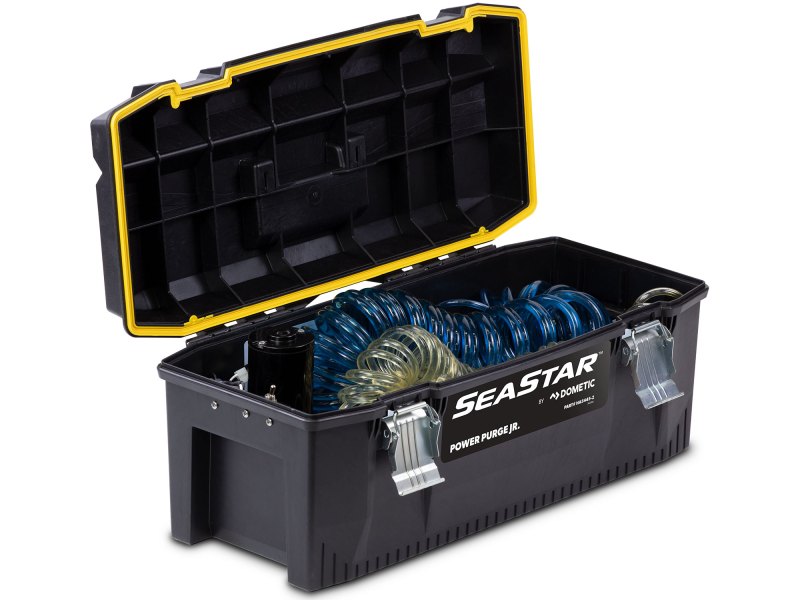 The 12-volt Power Purge Jr. from Dometic makes purging a hydraulic system a breeze.
Courtesy Dometic
BUY NOW
Purging the System
The 12-volt Power Purge Jr. from Dometic makes purging a hydraulic system a breeze.
Courtesy Dometic
BUY NOW
Purging the System
Once you have installed an autopilot system for hydraulic steering, you must fill the system with hydraulic fluid and purge the system. The 12-volt Power Purge Jr. from Dometic makes this a breeze. Once the quick-connect hoses are attached and the bleeders are open, fill the reservoir in the kit, turn it on, and follow the procedure to quickly and cleanly purge all air from the system. $1,199.99; nvnmarine.com
The post Pointers for Installing an Autopilot appeared first on Boating Mag.