How to Choose the Best Livewell System for Your New Fishing Boat
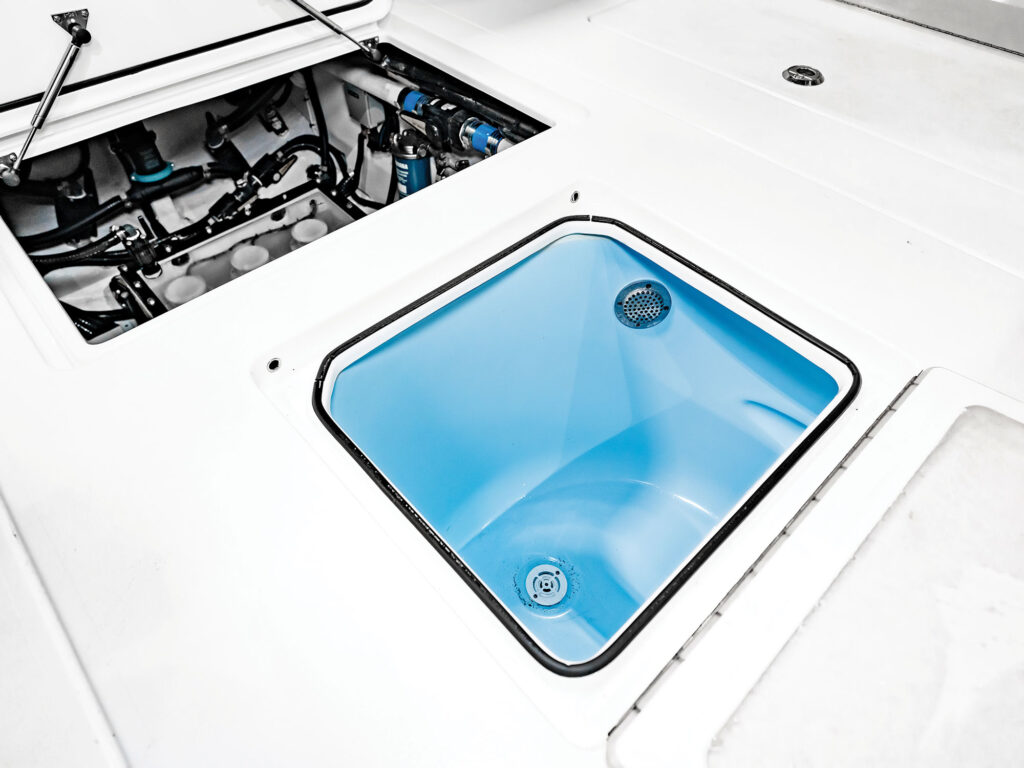 An aft, in-deck livewell is the safest spot for baits.
Courtesy Contender
An aft, in-deck livewell is the safest spot for baits.
Courtesy Contender
You managed to steal away from work just as packs of Atlantic sailfish began to ride a cold front down the Atlantic coast of Florida. The sails are swarming the kite baits and the crew hoots as they triple-up for the second time in a row. Enthusiasm on the boat is at a fevered pitch. It’s the kind of day you’ve dreamed about for a month and then you take a peek in the transom livewell and somehow the four dozen goggle-eyes you forked over upwards of $400 for and crammed into your livewell are all but gone. The options are not good—run back to the dock to pick up more baits and hope the fish don’t bugger off, or end the most epic day of the year short. Running out of bait can ruin the day just about as fast as an engine failure.
The good news is it doesn’t have to end this way. Today’s center consoles and diesel convertibles offer a range of livewell options for all styles of fishing. And the best time to outfit your vessel with bait capacity galore is when you sit down with your dealer or manufacturer and plan out a new build. Retrofitting an existing livewell system is expensive and difficult, so you’re better off getting it right the first time. Luckily, boats come with so many livewell options you can personalize your bait management system to meet the way you fish.
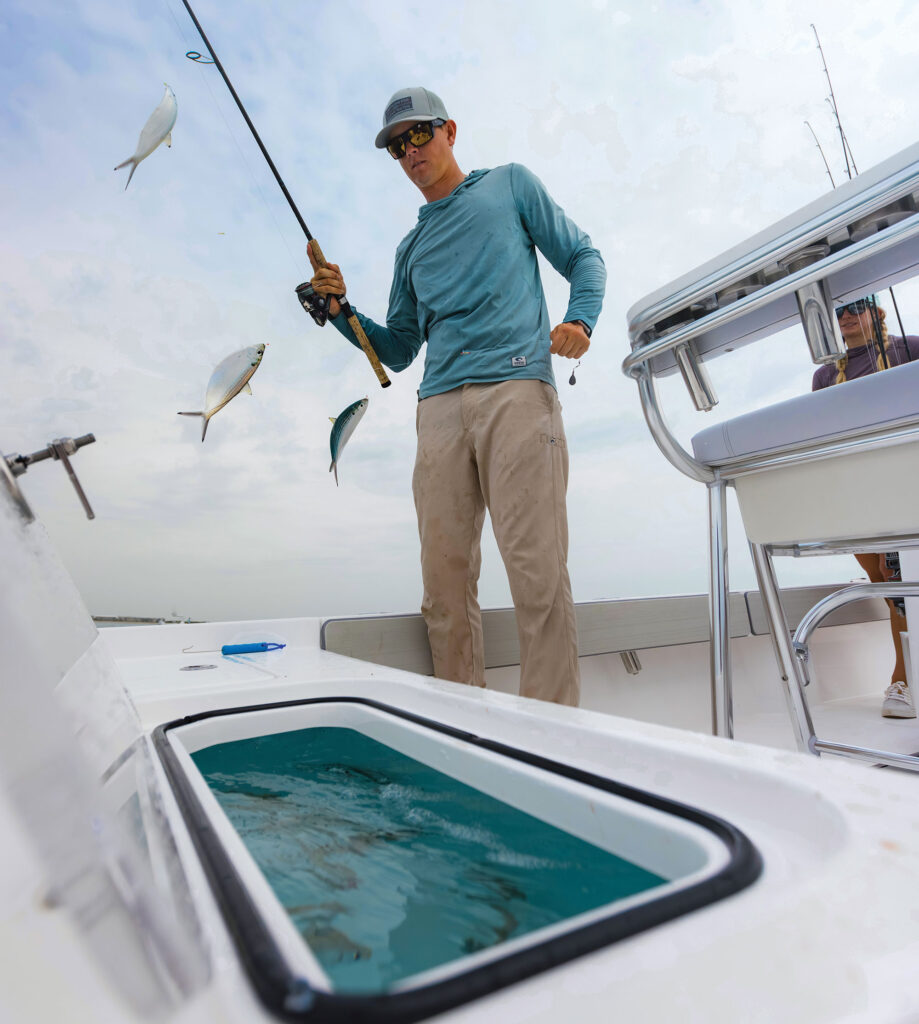 Livewells in the stern or transom are easier on bait.
Courtesy Contender
Capacity and Location
Livewells in the stern or transom are easier on bait.
Courtesy Contender
Capacity and Location
When choosing a livewell, you want it to be round or oval so the baits can swim without smashing their noses into the side of the tank. And as for size, go as big as possible. It’s always better to have too much space than not enough. You don’t want to run out of bait when those sails start chomping. If you aren’t using the tank for bait, you can always use it for storage. And if at all possible, avoid livewells with standpipes, an obstacle that is pretty much obsolete.
Boatbuilders commonly offer standard livewells in the transom and optional livewells under the cockpit sole, in the leaning post, under a forward seat or up on the bow. The safest place for bait, however, is in the aft—from amidship to the transom offers the smoothest ride.
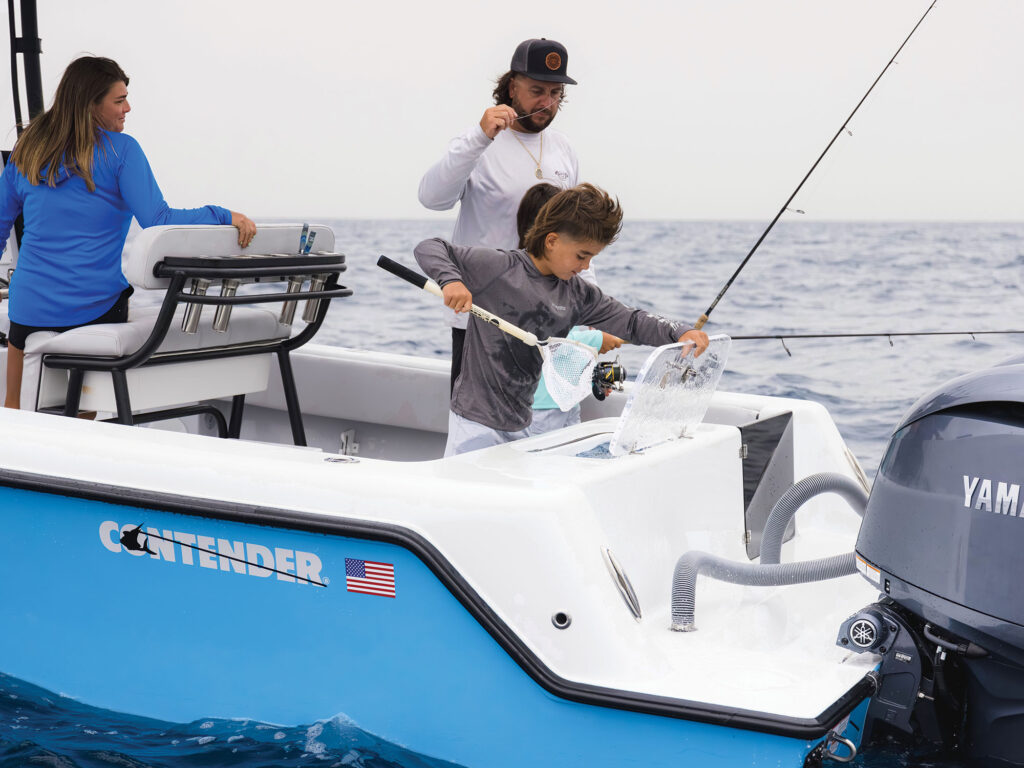 The transom is an ideal location for easy access when fishing.
Courtesy Contender
The transom is an ideal location for easy access when fishing.
Courtesy Contender
“Baits are always happier in the back of the boat where there’s less movement going on,” says Chris Becker, naval architect for Contender Boats. “You must consider the load you’re adding to the boat, whether it’s going to throw off the balance side-to-side or change the center of gravity. On bigger boats, you’re talking a huge quantity of water, which is a huge amount of weight. The boat needs to be designed to run correctly with and without all of that water weight.”
Most fishing vessels offer one large well across the transom, two smaller wells in the aft corners or a mix of both. There are pros and cons to each configuration. Having one big tank is good for carrying a large amount of bait in a single location, which also means less plumbing. Having two tanks, one in each corner, let’s you separate the bait by species or place baits on either side of the boat to give anglers handy access from the corners. You can also opt for an in-deck livewell.
“The movement of the boat is exponentially exaggerated up front,” says Jon Cooper, a Contender sales person who fishes tournaments with the Contender team. “That’s why we put the most fragile baits in the floor. That’s the safest, calmest spot in the boat.”
When choosing a layout, consider how easy it’ll be to get bait into the livewell and take it out. An aft, in-deck livewell may be the safest spot for bait, especially if the boat has a gyrostabilizer on board, but bending down to dip-net bait all day can be difficult on the knees and back. These tanks are often used when holding large amounts of bait and transferring them to the transom well for fishing, or a dockside pen.
Smaller boats have fewer options for livewells which means putting them in locations such as leaning posts or underneath seats that can be a bit tricky to access at times. Emptying a cast net full of jumping pilchards into a waist-high leaning-post livewell requires some serious shoulder strength. Some guides will use a tote to dump baits out of the cast net and then place them in the well to avoid bouncing them off the deck which removes their slime coat and diminishes their liveliness. Make sure there’s no obstructions that could snag a cast net.
 Controlling the flow of water is key—you don’t want too much flow or too little.
Courtesy Contender
Pump Systems
Controlling the flow of water is key—you don’t want too much flow or too little.
Courtesy Contender
Pump Systems
The pump box or sea chest is the heart of the boat’s livewell system and they vary from boat to boat depending on the number of livewells and hull shape. Water is sucked into the sea chest via through-hull or transom-mounted pickups. Step-hulls create a lot of aeration when running so a high-speed transom pickup often works better. Through-hull pickups are fine for V-shaped monohulls, but again, the final decision is up to the wants and needs of the owner. And when it comes to pumps, redundancy is your friend. If one pump fails, just turn a valve and there’s a secondary pump to fill you back up.
Mike Padgett, owner of Best Marine Pump, has worked with a long list of center console manufacturers and he’s tested just about every intake on every hull, from high-speed catamarans to step-hulls. “We’ve gone the full gamut from crazy, absolutely insane to the simplest two-pump system for a single livewell,” he says. “I’ve done systems that had 22 pumps and 22 tuna tubes.” That’s above and beyond for most crews.
 Best Marine offers high-speed transom and flush-mounted pickups which are a far cry from the bulky bronze clamshells of yesteryear.
Courtesy Best Marine
Best Marine offers high-speed transom and flush-mounted pickups which are a far cry from the bulky bronze clamshells of yesteryear.
Courtesy Best Marine
Best Marine offers high-speed transom and flush-mounted pickups that are a far cry from the bulky bronze clamshells of yesteryear. They also have standard two-, three- and four-pump sea chests. The pumps in the box range in size up to 3700 gph. “Most of the manufacturers are moving towards the larger pump sea chests that go to manifolds,” Padgett says. The manifolds connect the water coming out of the pumps to the plumbing that directs flow to the various livewells or accessories that require water for cooling such as generators, gyrostabilizers and chillers.
Larger center consoles may have three inlets coming in to feed the box so there’s always enough volume and the sea chest won’t go dry if you turn on all of the pumps. And each pump will feed the manifold. You could go with one, two, three or four pumps depending on how many tuna tubes or livewells you’re running. The system is easy to control with valves in the lazarette. If one pump dies (keep in mind that new pumps don’t die nearly as often) you won’t risk losing a load of precious baits. Best Marine offers a composite manifold design with valves mounted on it and when it comes to the plumbing, try to steer clear of 90-degree turns that can alter flow rates.
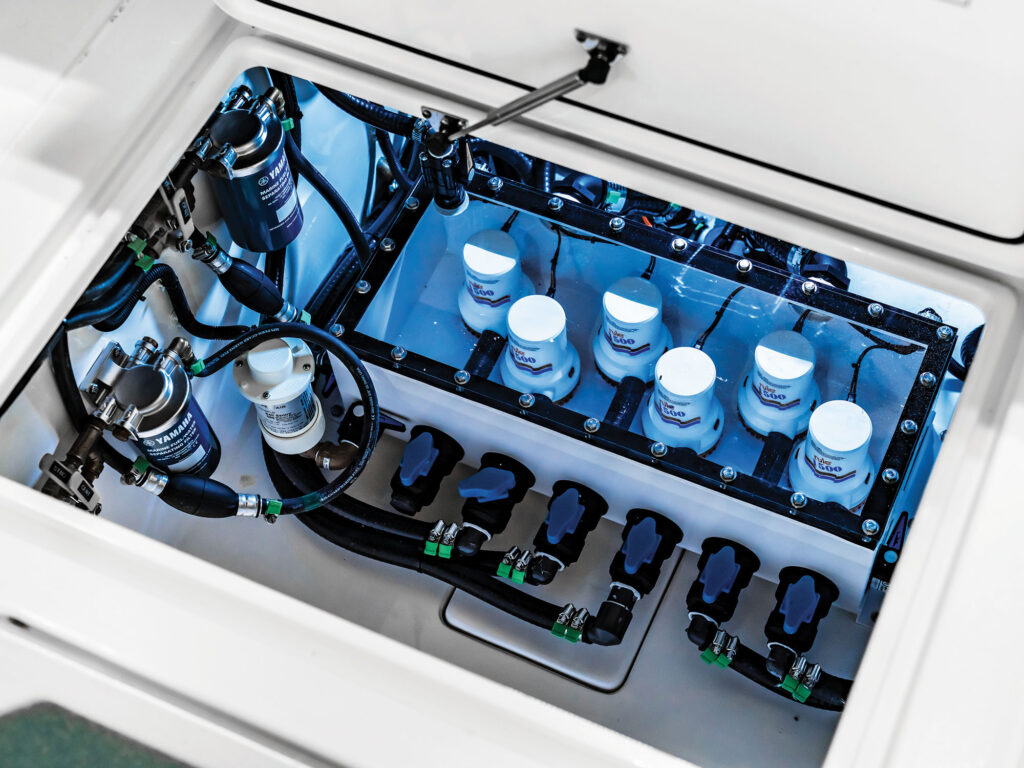 Redundancy is your friend when designing a sea chest. If one pump fails you simply flip a valve to pull water from another pump. Larger center consoles have multiple livewells and on-board systems such as a gyro or air-conditioning that demand raw water for cooling.
Courtesy Contender
Redundancy is your friend when designing a sea chest. If one pump fails you simply flip a valve to pull water from another pump. Larger center consoles have multiple livewells and on-board systems such as a gyro or air-conditioning that demand raw water for cooling.
Courtesy Contender
“You never want to be down, so redundancy is huge with that manifold system,” Cooper says.
A sea chest will run most efficiently when placed below the waterline. “It needs to be well below the waterline because every inch below, when you’re static, is a tremendous amount of flow difference,” Padgett says. “The lower, the better. It’s one of the things we’ve learned—lowering it a few inches changes everything.”
As for pulling debris into the sea chest, it’s not much of an issue with high-powered pumps. There are baskets on the bottom of the pumps, some folks call them cheese graters, and they’ll catch bits of flotsam, but seaweed gets chewed up and spit out without impeding the impellers.
Pressurized systems keep the livewell completely full so baits do not slosh around while underway. When a tank is fully pressurized, the lid can be hard to open. Crews can control the pressurization so once you’re drifting or slow-trolling, you can relax the flow and keep the water in the livewell at a normal level so it’s easier to open the lids or you just leave them open with very little overflow. A control valve on the transom or in the lazarette or bilge makes tweaking the pressurization a simple affair. You don’t want too much, or too little. The sea chest’s air-relief or bleed-out valve is a key component to remove any air that ends up in the system so the pumps do not get air locked.
 A clear livewell lid lets in ambient light so bait can avoid bumping in to the sides of the tank.
Courtesy Contender
Color, Lights and Lids
A clear livewell lid lets in ambient light so bait can avoid bumping in to the sides of the tank.
Courtesy Contender
Color, Lights and Lids
Each manufacturer varies when it comes to choosing the color of the gelcoat of a livewell. Serious bait anglers often opt for darker colors to cut down on glare when opening the livewell lid. A bright-white tank may give the baits a flash of glare when opening the lid which shocks them, similar to turning on a light after sleeping in a dark room. But if you go too dark it can make it tough to see baits in the tank.
“A lot of people choose the color of their live wells,” says Cooper. “We color the livewell to take the edge off of that bright white gelcoat. When you introduce a threadfin herring into an empty well and it’s bright white, they freak out and start darting all over the place. Whereas with even a light blue, something to take the edge off, they’re much calmer. The real dark blues, I’m not a fan of. They’re almost too dark.”
A clear plexiglass or acrylic lid, as well as a viewing window, will let ambient light in so the baits aren’t shocked with a flash of bright light when opening the top. Lids and windows are also helpful when monitoring water levels. However, scratching can be an issue with clear lids. Yet another thing to consider.
Each region fishes live baits a little different. Can you ever have too much live bait on the boat? The answer depends entirely on your boat’s livewell capacity. Everything tends to grow as the fishing gets more intense.
The post How to Choose the Best Livewell System for Your New Fishing Boat appeared first on Salt Water Sportsman.