Honing Deepwater Release Tactics While Fishing for Kitty Mitchell
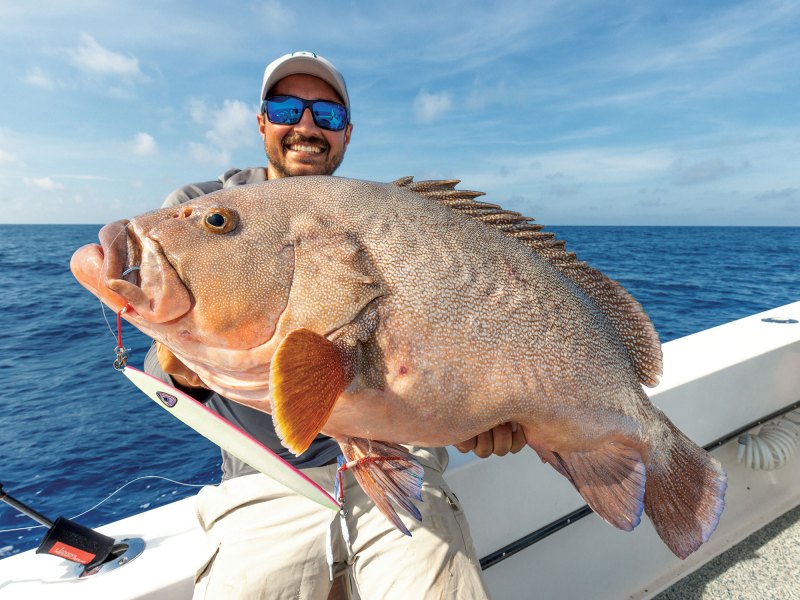 Deepwater fish like speckled hind suffer from barotrauma, reducing their chances of surviving after release.
Andrew Redwine
Deepwater fish like speckled hind suffer from barotrauma, reducing their chances of surviving after release.
Andrew Redwine
On the west central coast of Florida, the continental shelf slopes gently towards the abyss. Eventually, far from shore, out in 600 to 700 feet of water, you’ll find one of bottomfishing’s most mysterious species: the speckled hind, commonly known as kitty mitchell. These fish are a dream catch for many, not due to the meat quality, but rather their size, mystique and beautiful coloring: white specks covering a purple-orange skin tone. They live in deep waters of the Gulf and South Atlantic and remain out of reach for many, but not for Capt. Anthony Belmonte of Figured It Out charters. April and May are prime months when the weather starts to warm and big bait schools stack up, with kitty mitchell often feeding far below.
Planning for the UnknownRunning to the kitty mitchell grounds, a nearly 250-mile round trip, demands far more than a typical offshore day. For our crew, it began the night before at Pisces Sushi and Global Bistro in Dunedin, Florida. Ryan Morie, Johnny Jigs and I met to map out our game plan while enjoying some of the freshest raw seafood around. Jigs had landed a single kitty in the past, but for me and Morie, this would be a first. Our primary goal was to check off this bucket-list species, and to do it on jigs. As a bonus, we planned to target yellowedge grouper and blueline tilefish in the same fishing area.
A key part of planning any offshore trip is understanding the regulations, not just for our target species, but for anything we might encounter as bycatch. That’s where things got tricky with kitty mitchell: Regulations only allow one per vessel, yet each of us wanted to land one on a jig. If we succeeded, it meant releasing two of them. When you’re dropping a piece of metal 600 feet to the bottom, there’s no telling what might bite, so it pays to be prepared for whatever comes up.
A Moral DilemmaThe moral dilemma of deepwater fishing is very real: You may hook your dream fish, but if regulations prevent you from keeping it, its chances of surviving release from depths over 600 feet are uncertain at best. Reef fish pulled up from depth experience severe injuries from the pressure change, known as barotrauma. Survival isn’t impossible, but it’s far from guaranteed. Some anglers insist the fish won’t make it no matter what, while others, including Belmonte, firmly believe that with the right handling and release, some do survive. The science on survival at these depths (over 300 feet) is still extremely limited but there is some encouraging data showing survival is possible. Regardless of the likelihood, the best practice remains to avoid releasing fish in deep water whenever possible, and if you have to, use a descending device to get them back to depth.
We came prepared with descending devices to give any fish we released the best possible chance at survival. If we ended up releasing a kitty mitchell, we planned to document it by pushing our GoPros well beyond their 196-foot depth rating in hopes of capturing a rare glimpse of a 300-foot descent back to the bottom.
Race to the SurfaceWe met at the dock in Madeira Beach at 3 a.m., loaded up Belmonte’s 36-foot Contender, claimed our bean bags, and settled in as we pushed off into the darkness. Hours of running offshore beneath a sky full of stars, with the Milky Way stretched overhead, put the sheer scale of the Gulf into perspective. The time slipped by quickly, and four hours later we eased into our first spot just as the sun began to rise over calm, rolling seas.
Jigs, Morie and I geared up and readied our 600-gram torpedo jigs for the first drop in what Morie cleverly coined “The Litter Box.” At Belmonte’s signal, we made our first drop, watching line peel off as they sank through what felt like an endless water column before finally touching bottom. Minutes later, Morie was tight, followed by an audible shout from Jigs, who was also hooked up to something big.
Morie won the race to the surface, landing his personal-best blueline tilefish on the very first drop. It wasn’t the fish we were chasing, but a double-header to start the day was a promising sign of what was to come. As Jigs’ fish slowly made its way up the water column, his line began to scope out, hinting at a grouper species rising from barotrauma. We had come for one specific fish, and on the very first drop, Jigs had already secured our target species, and his second kitty mitchell ever.
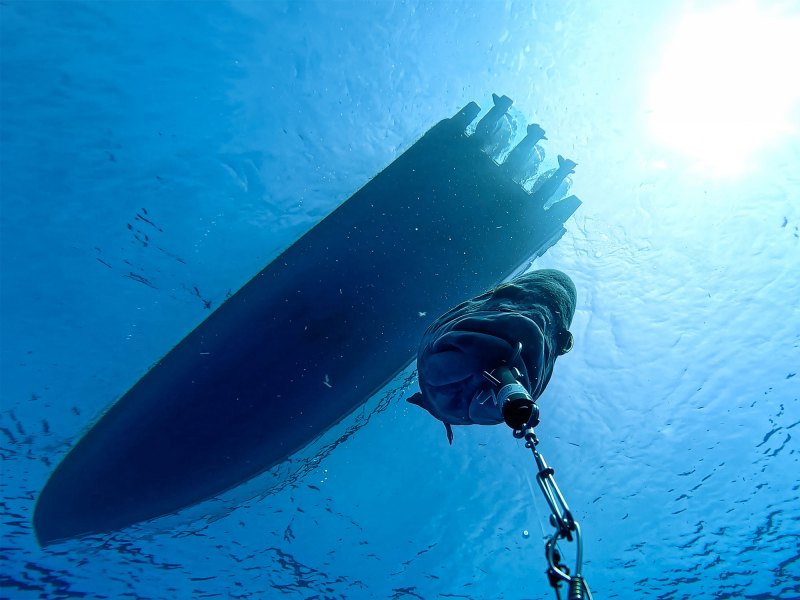 A GoPro camera captures footage of a kitty mitchell heading 300 feet down for a SeaQualizer release.
Courtesy Nick Haddad
A Successful Release
A GoPro camera captures footage of a kitty mitchell heading 300 feet down for a SeaQualizer release.
Courtesy Nick Haddad
A Successful Release
We were thrilled for Jigs, but that meant our vessel limit had been reached, and any additional kitties would have to be released. I felt a knot of nervousness at the thought, as Jigs’ catch had the worst barotrauma I had ever witnessed. Its eyes were bulging, its stomach had prolapsed from its mouth, and the pressure change had even blown a new hole in its belly, something I’d never seen before. This fish was destined for the box.
We decided to try another spot for kitties before heading to the yellowedge grounds. Jigs hooked up again and landed an even bigger kitty that was in surprisingly good shape, showing minimal barotrauma. We hooked it to a SeaQualizer descending device set to release at 300 feet, sent it down with the camera facing up. The clarity was incredible, though we didn’t send the camera deep enough to see the fish swim off. Lesson learned: Next time continue dropping the camera after the fish releases.
At the next stop, it was my turn. I felt a thump, set the hook with a few hard pumps and slowly brought up what felt like a sunken Volkswagen. It was another giant and my first kitty mitchell. After a quick photo, we sent it down on the camera rig, this time letting it descend farther. After retrieving the GoPro, we huddled up, eagerly waiting to see what it captured. The fish released, kicked, turned, and swam out of frame. We couldn’t know for sure if it survived, but we gave it the best chance.
The action never let up the rest of the day. We pushed deeper and Jigs and Morie picked off yellowedge on jigs while I added a few on the electric. Each drop carried the same anticipation, lines disappearing into the depths before loading up again, reminding us just how alive the bottom was. Just when we had all but given up on Morie getting a kitty, the ocean delivered his first, coming unexpectedly from a yellowedge spot on the final stretch of the day. It was the kind of moment that turns a great trip into an unforgettable one.
Read Next: Return ‘Em Right Tips for Safely Releasing Reef and Bottomfish
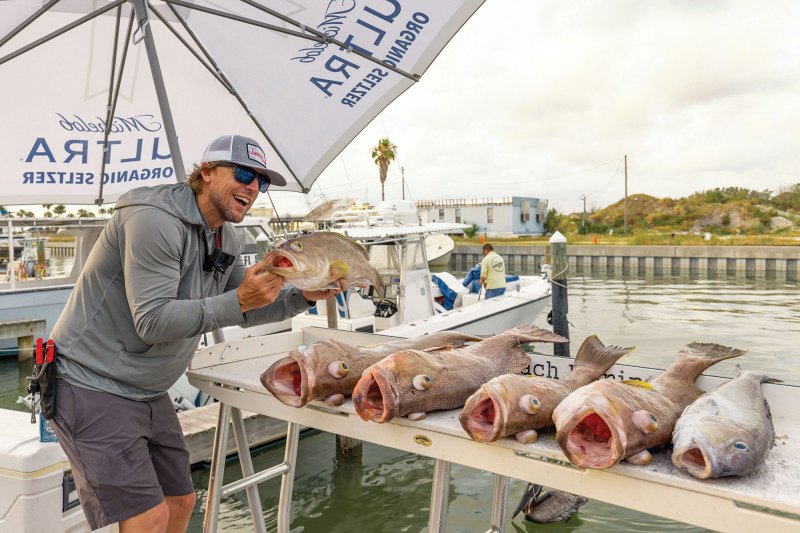 The 250-mile round trip filled the fish box.
Andrew Redwine
Lessons From the Deep
The 250-mile round trip filled the fish box.
Andrew Redwine
Lessons From the Deep
Deepwater fishing is about as thrilling as it gets, but it also comes with real responsibility. As we push farther offshore and fish deeper waters, there are more challenges to address. If we want to minimize our impact on these fisheries, the best approach is to reduce unnecessary releases whenever possible. The reality is the deeper you fish, the slimmer a fish’s chances of survival.
But exploring the deep isn’t something to shy away from. It’s one of the most rewarding experiences offshore fishing has to offer. Knowing and sharing the realities of deepwater fishing, from barotrauma to release survival, isn’t about discouragement. It’s about being prepared, fishing responsibly, and making informed decisions once you’re out there.
The post Honing Deepwater Release Tactics While Fishing for Kitty Mitchell appeared first on Salt Water Sportsman.