Even in Spirit, Turner Gets In the Last Word
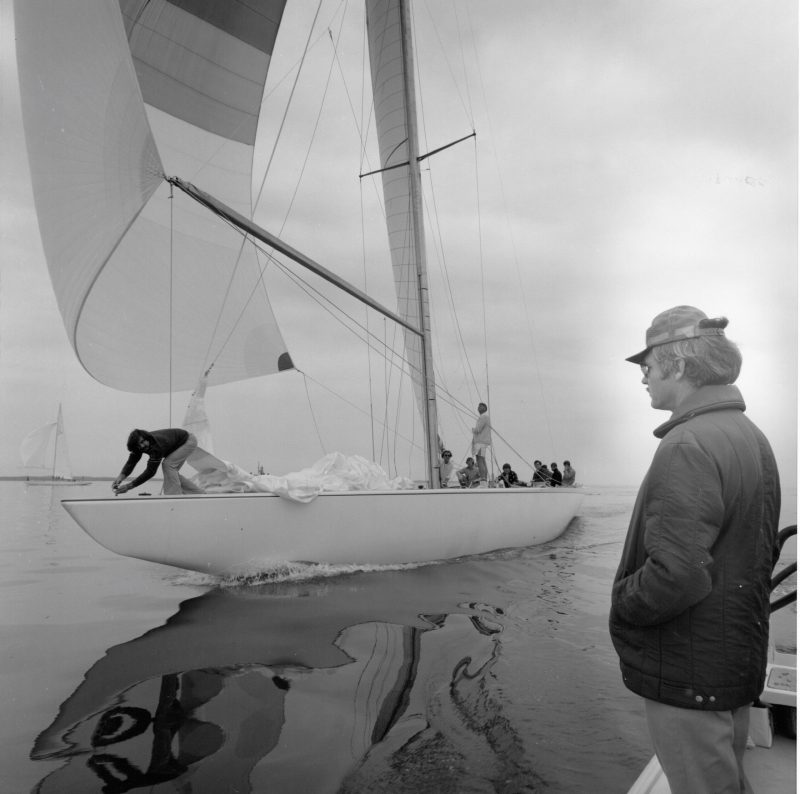 Ted Turner eyes Courageous as it sails past.
Mitch Carucci/Sailing World Archives
At a recent celebration of life for Ted Turner, I was reminded of a moment during the 1977 America’s Cup. It was the early defender trials in June and we had won six races in a row aboard Courageous. After the sixth win, Turner invited me to the Armory for the press conference. I had never been to a press conference. John Ahern, a writer for the Boston Globe, asked Turner how he was able to win.
“Well we have a strong crew with Gary reading the wind and calling tactics,” Turner said matter of factly, “and our sail trimmers, Robbie Doyle, Bunky Helfrich and Richie Boyd making us go fast, is the reason we are doing well.”
I decided then and there that I like the press conference. The very next day we lost.
Mr. Ahern then asked, “What happened today, Ted?”
Without missing a beat, Turner replied, “I had a bad day and made a few mistakes. We will try to do better tomorrow.”
I was sitting next to Turner on the podium thinking that we really lost because I missed a wind shift and we had set the wrong headsail, but the lesson was clear; when we won, he spread the credit. When we lost, he took the blame.
This moment serves as an example of the leadership style that defined Turner’s legacy, which was celebrated in Atlanta at the former CNN Center on November 14, 2026. I was honored to serve as Master of Ceremonies for the tribute. A distinguished group of speakers spoke to nearly 350 invited guests about Turner and his amazing career: Senator Sam Nunn, U.N. Ambassador Andrew Young, Stan Kasten, who ran the Atlanta Braves for Turner when the team won the World Series. Also sharing memories was Turner’s one-time roommate Peter Dames, his ex-wife Jane Fonda and three of his grown children; Laura Seydel, Teddy Turner and Rhett Turner. There was a six-person ensemble that performed four of his favorite songs, and a film tribute of his life.
Turner accomplished a lot over his 87 years. Sailing was just one of many facets to his life. While listening to the speakers I reflected on him as a sailor and what made him special.
The speakers spoke about the lessons they learned from him, like the need to “aim high” or to embrace difficult challenges, and we learned about comical shenanigans during his prep school and college days. Everyone in attendance had their lives touched in a positive way thanks to Turner’s influence.
I first met him in 1969, before the start of the Annapolis to Newport Race. I was 19 and Turner was 31. He won that race aboard the 12 Meter American Eagle. I started racing with him in 1976 and my role on the boat was either tactician or watch captain. It was quite a ride. Since those heady days I have given more than 3,000 lectures across the country and around the world. The most frequent question that I have been asked is, “What’s it like to sail with Ted Turner?”
That’s an easy question.
Turner was an excellent helmsman. He had a knack for making a boat go fast. He was also a keen observer of our performance and loved making adjustments and experimenting with trim, tuning and tactics. Let there be no doubt that winning was important. He would rather risk losing by taking big chances than settling for a mediocre finish.
For example, in 1973 he finished fourth in the Fastnet Race. He later said, “Finishing fourth out of 200 isn’t bad, but of course finishing first would be better.” In 1979, he had the singular goal of winning The Fastnet aboard his S&S 62-foot sloop, Tenacious. That year we won Cowes Week, including the prestigious Queen’s Cup. It was rare for an American boat to win the Queen’s Cup in the United Kingdom.
After the race, a representative of the Royal Yacht Squadron arrived at the dock with four invitations to the prizegiving that evening. Turner looked at the well-dressed courier and said, “There are only four invitations here, but we have 16 crew. Either we are all coming or none will attend.”
The courier returned 30 minutes later with 16 invitations. It was vintage Ted Turner.
He did win the 1979 Fastnet Race, which to this day is considered the roughest ocean race on record. He also sailed a second-hand 12-Meter, Courageous to defend the America’s Cup in 1977.
I once asked him which of these he considered his most important victory. “The 1979 Fastnet,” he said, “but the America’s Cup is a close second.”
Turner was named US Sailing Yachtsman of the Year four times (1970, 1973, 1977, 1979). He raced with an all-amateur crew. I once asked him if he would pay for my airline ticket, and his response was an emphatic denial. “Everyone who sails with me pays for their own travel,” he told me, “and you will too if you want to sail with me.”
I never asked again.
Over the five-year period that I raced with Turner we won the America’s Cup, the Congressional Cup, the Fastnet Race, Annapolis to Newport Race, the Southern Ocean Racing Conference and a variety of big boat races around the country. The name of Turner’s boats was in sync with his business acumen: Tenacious and Courageous. Turner did well in small boats, too, and he was often a podium finisher in the Flying Dutchman class and raced 6-Meters at the World Championships. At one 6-Meter regatta, the late Tom Blackaller asked Turner if he would like to wager on the racing. “Well, how much do you have?” was Turner’s response.
Blackaller backed down once he realized he might be in over his head.
Turner didn’t always win, however. In fact, he had some dismal sailing campaigns, none worse than the 12 Meter Mariner in 1974. The boat was seriously off the pace of the other defenders. Turner had a great line he used in sports, including basketball, baseball and boating (the Bs): “We’re not losing, we’re just learning how to win.”
This simple philosophy served him well in his business career along with his sporting life. That’s true of the Atlanta Braves which were perennially in the cellar in the National League but eventually became a powerhouse, winning pennants and the World Series.
The Wall Street Journal once published an article written by Peggy Noonan with the headline, “Can America Make Any More Ted Turners? It’s a valid question for today. Turner changed the world with CNN and how we watch television news. He created thoughtful movies and television programs, cared about the environment and wanted to get rid of nuclear weapons. He believed in the value of the United Nations, he was concerned about global overpopulation and he was a protector of wildlife and wild lands.
He had a bumper sticker on all his various work vehicles—farm equipment, trucks and tractors—that said, “Save Everything.”
The post Even in Spirit, Turner Gets In the Last Word appeared first on Sailing World.