The Benefits of NMEA-2000 Networking
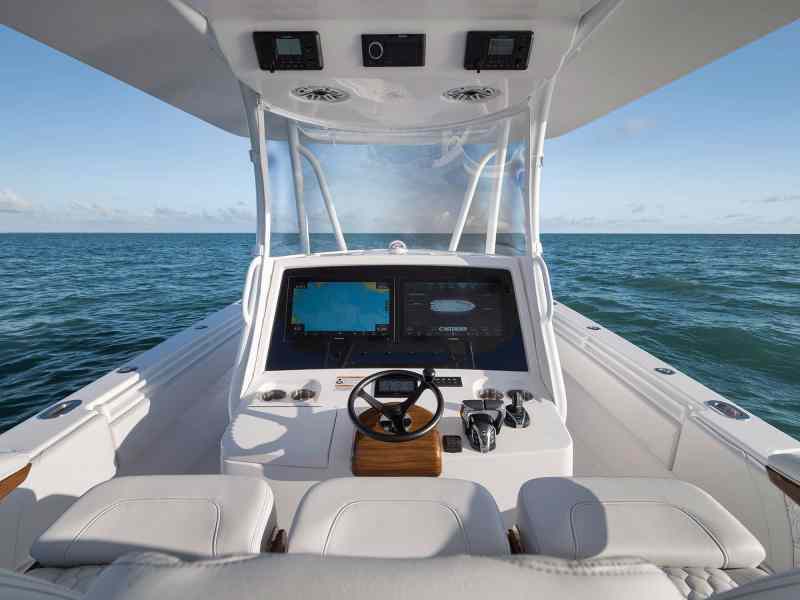 NMEA-2000 networking components lie hidden behind the helm, but are manifest in greater navigational safety, easier monitoring and control of onboard systems, and the ability to find fish faster.
Courtesy Contender
NMEA-2000 networking components lie hidden behind the helm, but are manifest in greater navigational safety, easier monitoring and control of onboard systems, and the ability to find fish faster.
Courtesy Contender
I remember the first time I installed a NMEA-2000 digital networking system on my boat. It was simple do-it-yourself project—a single plug-and-play cable connecting the multifunction display at the helm to an external GPS antenna on the hardtop. That was in 2010, a number of years after the National Marine Electronics Association (NMEA) released this networking system for marine electronics and other compatible devices in 2001.
Today, some 26 years later, the NMEA-2000 (often abbreviated as N2K) network aboard my 21½-foot center console has expanded exponentially, integrating an array of marine electronics and other systems. This includes the VHF radio, AIS, radar, heading sensor, sonar, autopilot, Seakeeper Ride automatic attitude control system, and the outboard engine, as well as the main MFD and two smaller engine displays.
N2K has become the marine-industry standard for networking electronics. Many of today’s bigger fishing boats boast far more N2K integration than can be found on my boat. Take a close look behind the helm of a big center console, and you will find cross-networking of additional devices and systems such as remote digital switching, boat monitoring and security, marine audio, multiple MFDs, and much more.
Why Do It?What’s the point, you might ask? Why bother with all of this digital networking? To put it simply, N2K networking allows you to view, monitor and control onboard functions using one or more MFDs. What’s more, the system shares information with devices across the N2K network. So, for example, the radar can access heading data, the Seakeeper Ride can integrate boat-speed data, the MFD can display AIS targets, the VHF can use GPS to fully enable DSC distress alerts, and sonar information can be displayed on more than one MFD. That makes running the boat, navigating to angling hotspots, and finding fish easier, faster and more convenient.
N2K functionality is built into devices from every major marine electronics brand, including Furuno, Garmin, Humminbird, Lowrance, Raymarine and Simrad. N2K is a plug-and-play system with ready-made components that make it relatively easy to integrate marine electronics and other devices.
Yet, there are a few pointers to keep in mind when planning and creating a N2K network to ensure it functions properly. Also, like many things in life, your N2K network is likely destined to expand as you add new N2K-compatible devices. Anticipating future expansion is critical to the N2K planning process and to ensure that your NMEA-2000 network continues to function properly. Here are some pointers I have gleaned over a quarter-century designing, installing a N2K system and expanding it a number of occasions aboard my boat.
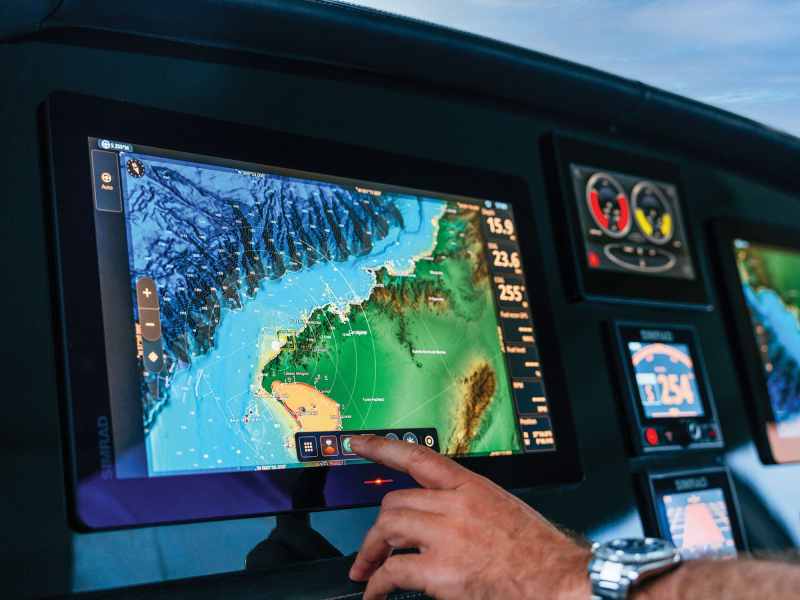 A properly designed and configured N2K network enables sharing of digital data across all onboard marine electronics, as well as access to that information via multifunction displays.
Courtesy Simrad
Power Delivery
A properly designed and configured N2K network enables sharing of digital data across all onboard marine electronics, as well as access to that information via multifunction displays.
Courtesy Simrad
Power Delivery
An N2K network requires 12-volt DC power. Special connectors with positive and ground wires (with inline fuses for the positive wire) let you supply onboard power to the so-called backbone, the main communication channel for the system. These power cables should be connected near the center of the backbone in order for the system to function properly. Make sure the power source you choose is 12 volts DC. Don’t connect your N2K network to any other power source such as 24 volts DC. This power cord energizes the backbone to send and receive data, be it depth information, GPS position coordinates, AIS targets, or more. If a backbone extension or drop cable reaches or exceeds 20 feet in length, an additional power cable is needed to ensure proper functionality of the N2K network.
T-CrossingsT-connectors serve as the intersections for the flow of digital information to and from marine electronics and other data sources. Small numbers of T-connectors can be strung together (at the point where the T is crossed) in a linear manner, directly with each other or via extension cables. You can also find available multiple T-connector ports grouped into one junction block, thus eliminating the need to string together a large group of single T-connectors. The series of T-connectors assembled in a linear fashion is known as the N2K backbone. There can be multiple backbones throughout the boat, each connected to the other via an extension cable. Backbones also can be expanded with additional T-connectors if and when new electronics are added.
Read Next: What Can Boating Anglers Expect From NMEA OneNet?
Short Drop CablesEach piece of marine electronics or data source connects with a single drop cable to the bottom port of a T-connector on one end and an N2K port on the electronics unit at the other. The drop cable serves as the on-ramp and off-ramp for digital information to be shared across the N2K network with all other electronics. As mentioned earlier, avoid using long drop cables. NMEA-2000 signals can be hampered by resistance, which causes a reduction in voltage. If you require a longer cable run to connect an item such as a transducer or sea-surface temperature sensor, use a T-junction either at the end or the middle of the run to tie in 12-volt power. Augmenting the power in this manner helps prevent an excessive drop in voltage.
Terminate or WaitAn NMEA-2000 backbone requires terminators at each end. You need to use one female terminator and one male terminator threaded cap at opposite ends of each N2K linear backbone. These are relatively simple threaded caps, but without them, the system will not function properly. So make sure the you equip each N2K backbone with these terminators.
The post The Benefits of NMEA-2000 Networking appeared first on Salt Water Sportsman.