TRM43: Trimarine and Barreau/Neuman Target the Blue-Water Performance Gap
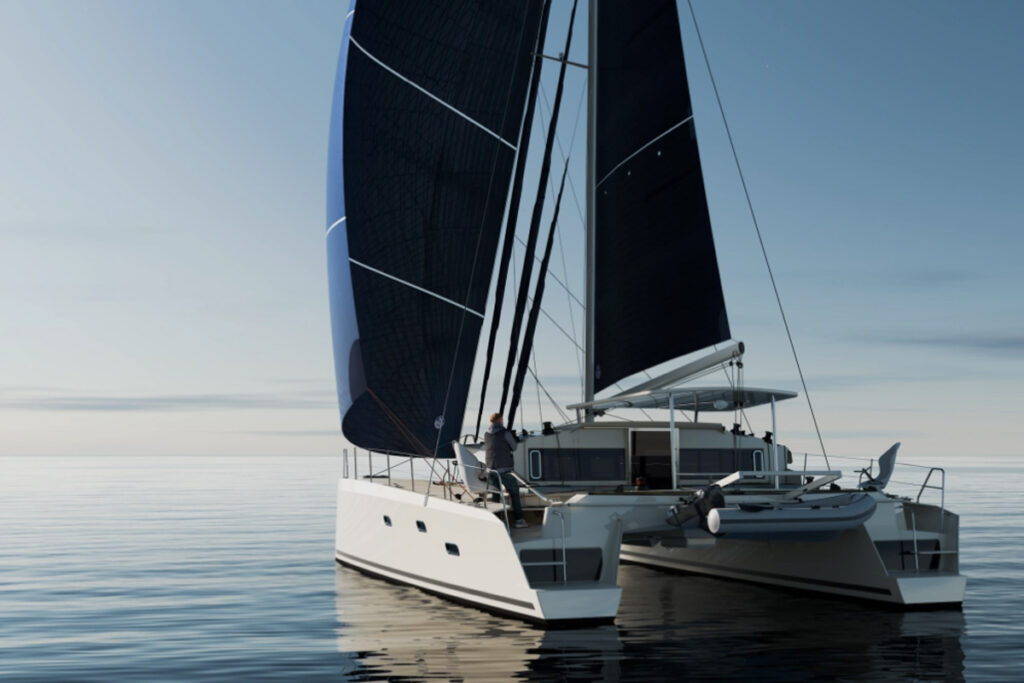 The TRM43’s fiberglass/carbon/epoxy composite hulls and 7.92-meter beam are engineered for bluewater passagemaking, not marina living.
Courtesy Trimarine
The TRM43’s fiberglass/carbon/epoxy composite hulls and 7.92-meter beam are engineered for bluewater passagemaking, not marina living.
Courtesy Trimarine
The brief was blunt: build the boat a veteran circumnavigator couldn’t find on any production floor. No concessions to charter agencies, no premium on cabin count, no compromise on weight. The result is the TRM43, a 43-foot performance cruising catamaran now announced by Lisbon-based Trimarine Compósitos Lda., with hull No. 1 scheduled for launch in 2026.
The project pairs naval architects Christophe Barreau and Frédéric Neuman, whose combined résumé spans nearly 30 years across Catana, Outremer, and Marsaudon Composites, with a yard whose pedigree runs from America’s Cup components to IMOCA 60s. The catalyst was a single owner who had completed one circumnavigation and set out to design a better boat for the second.
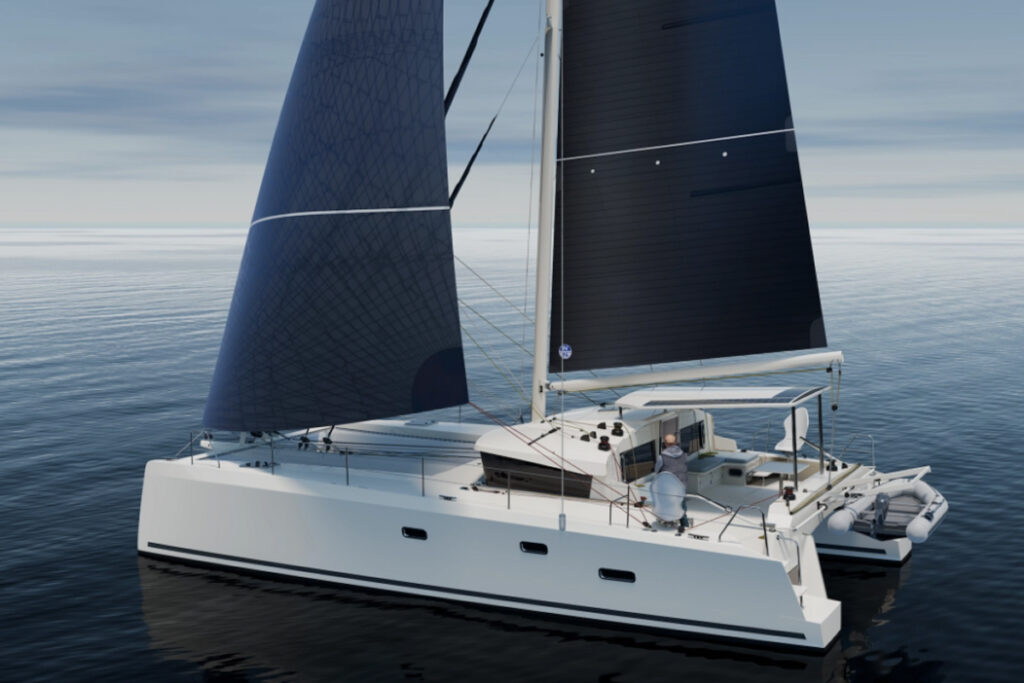 At 5.6 tons light displacement, the TRM43 needs just 2-3 knots of breeze to sail free of its engines, according to the builder.
Courtesy Trimarine
At 5.6 tons light displacement, the TRM43 needs just 2-3 knots of breeze to sail free of its engines, according to the builder.
Courtesy Trimarine
“Unlike their collaboration with these shipyards,” the design team notes, “the architects did not have to comply with any preset series specifications or commercial constraints.”
That freedom shows in the numbers. At light displacement, the TRM43 scales at 5.6 tons for a 13.08-meter (43-foot) hull—two to three times lighter than comparable production cats in the same size range, according to the builder. The beam stretches to 7.92 meters, the rig stands 16.35 meters off the deck, and the air draft tops out at 18.75 meters. Draft is adjustable between 1 and 2.5 meters.
The hull construction is fiberglass/carbon/epoxy over Corecell foam, with primary structural elements (bulkheads and main beams) laid up in carbon. The choice of epoxy resin over polyester or vinylester is deliberate: greater tensile, flexural, and shear strength, near-zero osmosis risk and a weight penalty that simply doesn’t exist. It’s the same logic racing programs have followed for decades; Trimarine has merely applied it to a cruising brief.
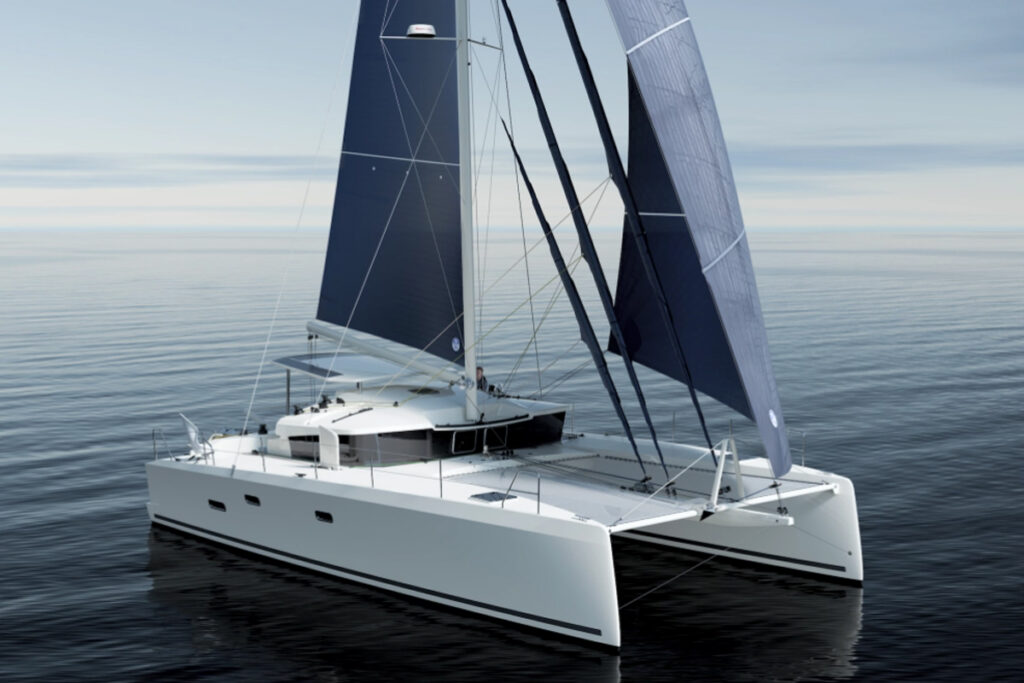 Naval architects Christophe Barreau and Frédéric Neuman brought nearly 30 years of performance catamaran experience to the TRM43.
Courtesy Trimarine
Naval architects Christophe Barreau and Frédéric Neuman brought nearly 30 years of performance catamaran experience to the TRM43.
Courtesy Trimarine
The design targets maximum autonomy with a minimalist layout, and the electrical philosophy reflects that. The first hull carries twin 460 Ah lithium battery banks, a solar array sized for indefinite anchoring without engine intervention, and a 40-liter-per-hour watermaker operable on 12V battery charge alone. A bimini-mounted rainwater collection system, the kind of detail that earns its keep on a long passage, feeds either the ship’s tanks or jerrycans directly.
Propulsion is twin Volvo D1-30 diesels at 30 hp each, driving Flexofold three-blade folding props via sail drive. The builder considered electric motors and declined, citing weight, reliability and range as the deciding factors at this stage of the technology’s development. At the TRM43’s displacement, 60 hp between the hulls is ample.
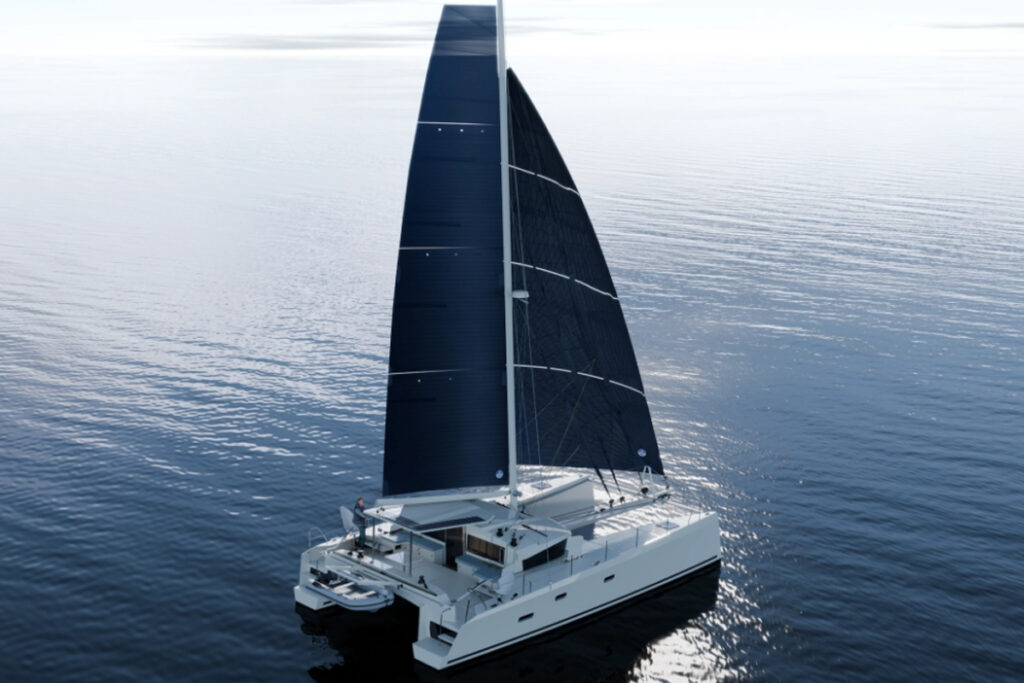 Twin Volvo D1-30 diesels, a 55 m² mainsail, and a 60 m² Code 0: the TRM43’s systems are chosen for reliability across oceans, not convenience at the dock.
Courtesy Trimarine
Twin Volvo D1-30 diesels, a 55 m² mainsail, and a 60 m² Code 0: the TRM43’s systems are chosen for reliability across oceans, not convenience at the dock.
Courtesy Trimarine
The performance targets are ambitious. The builder states the TRM43 needs only 2-3 knots of breeze to ghost free of its engines and sail at wind speed, and projects average daily runs of over 200 miles, with 250 miles achievable in favorable conditions. A 55 m² mainsail, a Solent ranging from 34 to 42.5 m² and a 60 m² Code 0 give the sail plan range from light airs to a building trade wind.
Berths are configured for 6 to 8, but the boat is built around a crew of one to four—the actual reality of most offshore passages.
Hull No. 1 is due for launch in 2026, with the design largely customizable to owner requirements. Trimarine Compósitos is based outside Lisbon, Portugal, where the yard’s 1,800 square meters of covered build space and direct water access handle everything from Ocean Race refits to custom performance multihulls.
For sailors who have spent years looking at the production catamaran market and finding it designed for someone else, the TRM43 is, at minimum, an honest answer to an honest question.
Full specifications and build enquiries: trimarine.com
The post TRM43: Trimarine and Barreau/Neuman Target the Blue-Water Performance Gap appeared first on Cruising World.